01
The right to human life and safety.
Human safety comes before technological or financial objectives.
AI systems and robots should be designed and used with safeguards that protect human life and physical safety.
We are entering a future shaped by intelligent machines. Our responsibility is to make that future more human—with a ten-point bill of rights that puts dignity, safety, agency, and opportunity first.
A commitment from Stonebyte
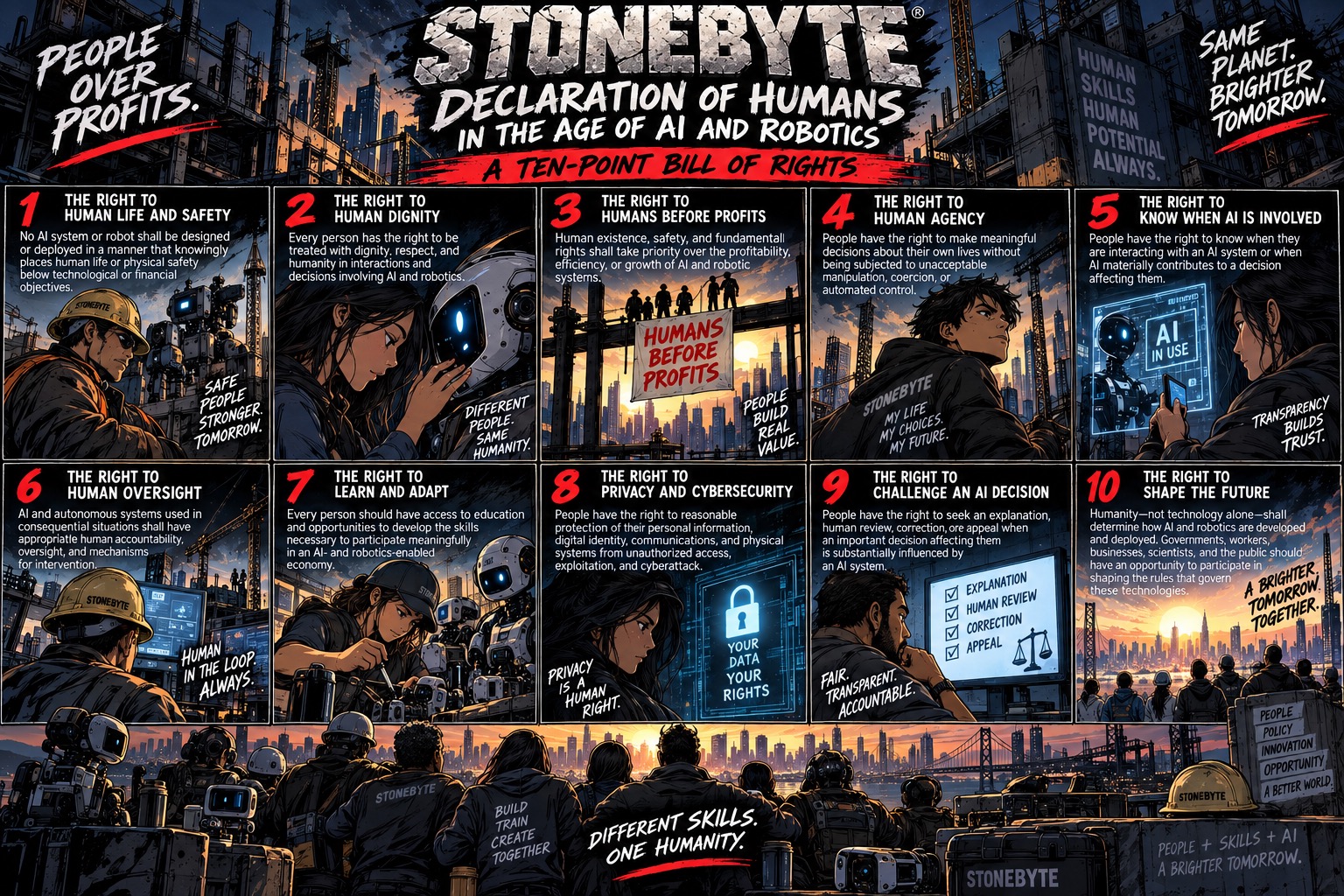
Our declaration
An illustrated declaration and the principles behind it: rights for people living, learning, and working alongside AI and robotics.
Human safety comes before technological or financial objectives.
AI systems and robots should be designed and used with safeguards that protect human life and physical safety.
Every person deserves to be treated with dignity, respect, and humanity.
That standard applies to every interaction and decision involving AI and robotics, regardless of a person's background or circumstances.
Human rights and safety must take priority over profit, efficiency, or growth.
No business goal should outweigh the fundamental rights of people affected by an AI or robotic system.
People should remain meaningfully in control of decisions about their own lives.
AI should not subject people to unacceptable manipulation, coercion, or automated control. People deserve choices they can understand and act on.
People deserve clear notice when they are interacting with AI or AI shapes a decision about them.
AI involvement should not be hidden when it materially affects a person's choices, opportunities, rights, or access to services.
Consequential AI systems need capable, accountable human oversight.
People must be able to reach a responsible human who can review a system's impact and intervene when needed.
Everyone deserves access to education that helps them navigate a changing world.
People should have opportunities to build the knowledge and skills needed to participate meaningfully in an AI- and robotics-enabled society.
Personal data deserves meaningful protection.
People should be able to understand and control how their information is collected and used, and be protected from unauthorized access, exploitation, and cyberattacks.
People deserve explanations and a way to appeal consequential decisions.
When an AI system materially affects someone, they should be able to seek an explanation, request human review, and challenge errors or unfair outcomes.
Humanity should help decide how AI and robotics are developed and used.
Workers, educators, communities, scientists, and the public all have a role in shaping the rules and priorities for technologies that affect our shared future.
From words to action
These rights are a standard for how we design and build. At Stonebyte, we put them into practice through the choices we make about learning, AI, and the future of work.
01
We are building career learning around exploration and simulated practice, giving people a place to learn and try skills before applying them in real work environments.
02
Our AI learning tools should explain, coach, and open up possibilities. Their recommendations should inform a person's choices—not define their abilities or decide their future.
03
We connect career discovery with practical next steps, helping people explore skilled trades and training routes even when they are still figuring out where they belong.
04
We center respect for people and safe practice in the way we teach skills and prepare the next generation for work alongside increasingly capable technology.
Our promise
We build technology to help people learn, grow their skills, and find their place in the future of work.
Stonebyte · The Safe Haven for Learning